After my husband Robert died, people kept asking me the same question.
“Are you doing okay?”
And every time, I gave them the same answer.
“I’m fine.”
It was easier that way.
Easier than explaining how painfully quiet a house becomes after forty-two years with the same person.
How you still wake up reaching toward the other side of the bed before reality catches up with you.
How you accidentally pour two cups of coffee in the morning… then stand there staring at the extra mug like your mind still hasn’t accepted what your heart already knows.
The truth was, I wasn’t fine.
Not even close.
After Robert’s heart attack, my world shrank down to almost nothing.
The grocery store.
Church on Sundays.
Doctor appointments.
And home.
Mostly home.
Days blurred together in silence.
The television stayed on more for background noise than entertainment. I stopped cooking real meals. Some afternoons I would realize I hadn’t spoken a single word out loud all day.
And then Diesel came into my life.
Nobody wanted him.
That was the first thing I learned about the dog.
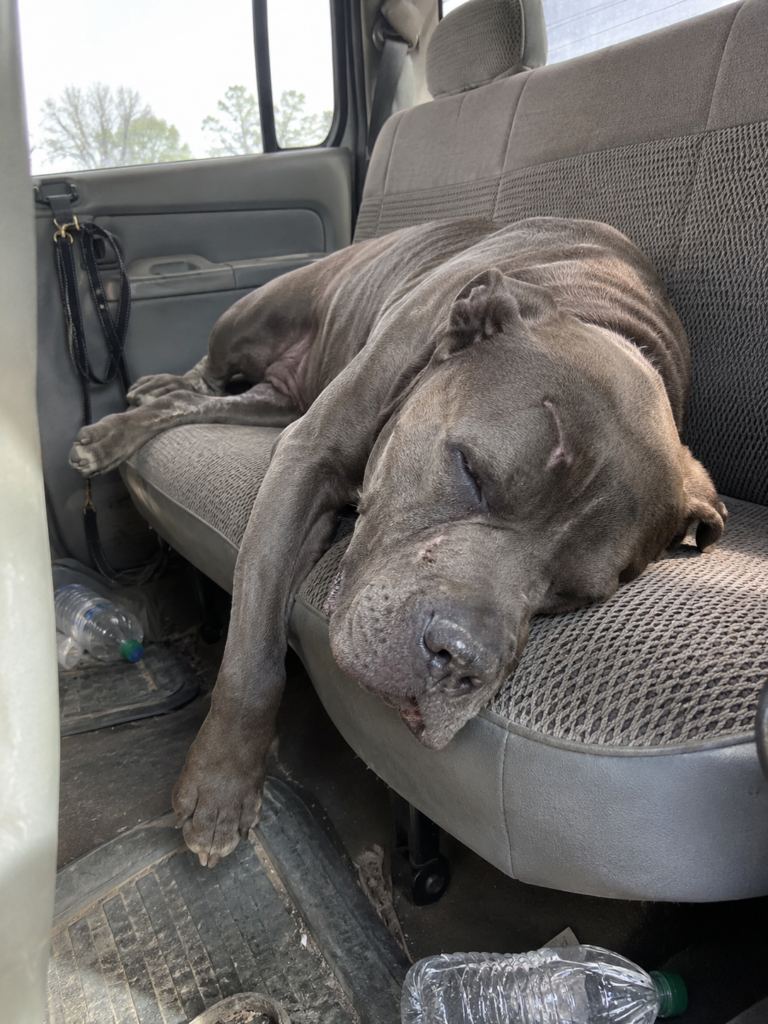
Diesel was a nine-year-old pit bull with broad shoulders, a scar across his muzzle, and the kind of appearance that made strangers grip their children’s hands a little tighter when he walked by.
The shelter described him as “intimidating.”
Potential adopters called him dangerous before they even touched him.
One family refused to meet him after seeing a photo.
Another specifically requested a different dog because their kids were scared of “the scary one.”
Meanwhile, Diesel spent most of his time carrying around a stuffed rabbit toy and sleeping with it tucked under his chin like a toddler clutching a blanket.
I adopted him six months after Robert passed away.
People reacted exactly the way you’d expect.
My neighbors thought I’d lost my mind.
My daughter worried constantly about liability.
One friend actually asked if I was afraid to live alone with a pit bull.
Afraid.
I almost laughed.
Because ten minutes after bringing Diesel home, he rested his giant square head in my lap like he’d known me his entire life.
And from that moment on, he barely left my side.
Every morning, he followed me from room to room while I cleaned or folded laundry.
Every evening, he curled beside my recliner while I watched old reruns I wasn’t really paying attention to.
And on the nights grief hit hardest — those awful three-in-the-morning moments where the silence felt unbearable — Diesel would appear beside my bed before my feet even touched the floor.
No barking.
No excitement.
Just quiet company.
Like he understood.
He became my routine.
My reason to get out of bed.
My reason to go outside when grief tried convincing me not to.
For the first time since losing Robert, I stopped feeling completely alone.
Then my son invited me to visit.
It was spring of 2025.
He called and asked if I’d come stay for the weekend so I could spend time with him, his wife, and the grandchildren.
I was genuinely excited.
Probably more excited than I should’ve been.
We hadn’t spent much real time together since the funeral. Phone calls were one thing, but I missed feeling like part of a family again instead of somebody people checked in on occasionally.
So I packed an overnight bag.
Loaded Diesel into the back seat.
And started driving.
The trip took nearly four hours.
Diesel slept through most of it, his gray muzzle resting against the seat while country music played softly through the speakers. Whenever we stopped for gas, he carefully climbed out, stretched his stiff aging legs, and leaned against me while I checked directions.
The closer we got, the more nervous I became.
I wanted everything to go well.
I wanted my son to smile when he saw me.
I wanted the weekend to feel normal.
When I finally pulled into the driveway, the house looked enormous.
Three stories.
Perfect landscaping.
Expensive stonework.
The kind of place Robert would’ve admired for at least ten straight minutes.
I walked up to the front door with Diesel beside me.
My son opened it.
For one brief second, I thought he was about to hug me.
Instead, his eyes immediately dropped to the dog.
His entire expression changed.
| Life Stage | Age | Max Time Alone | Reason |
| Young puppy | 8-12 weeks | 1-2 hours | Young puppies have small bladders and need regular potty breaks and attention. |
| Puppy | 3-6 months | Age in months + 1 | Older puppies have better bladder control, but are still potty training and need regular attention to prevent accidents and other issues related to boredom, loneliness, or anxiety. |
| Adolescent | 6 months to 2 years | 6-8 hours | By six months, potty training is typically complete. Even so, young dogs in adolescence have a lot of energy and need breaks and attention to let it out in constructive ways. |
| Adult dog | 2-8 years | 6-8 hours | Adult dogs have fully developed bladders, but they’re still prone to loneliness, boredom, and anxiety when left alone too long. |
| Senior dog | 8 years | 4-6 hours | Dogs often need more frequent bathroom breaks as they age. Cognitive decline and mobility issues may also shorten the time your senior dog can be alone. |
And the first thing he said to me wasn’t “How was the drive?”
It wasn’t “Mom, it’s good to see you.”
It was:
“You brought that thing?”
I felt embarrassed instantly.
The same sharp embarrassment you feel when someone criticizes you in front of other people.
I explained that Diesel stayed with me everywhere now.
That he was older.
That I didn’t like leaving him overnight.
My son sighed heavily before even responding.
Then he glanced back toward his wife, and the look they exchanged told me the conversation had already been decided before it started.
“We can’t have a pit bull in the house,” he said.
I tried explaining.
Diesel was gentle.
Old.
Well-trained.
He had never shown aggression toward anyone.
Not once.
But none of it mattered.
They talked about insurance.
Liability.
The neighborhood.
The children.
Everything except the actual dog standing quietly beside me.
And the entire time, Diesel sat calmly at my feet.
No growling.
No barking.
No pulling at the leash.
Just sitting there while people judged him for the shape of his body and the stories attached to his breed.
Eventually, my son offered what he called a compromise.
There was a detached storage building behind the house.
Finished interior. Climate controlled.
Diesel could stay there overnight.
Away from the family.
Away from the kids.
Away from sight.
Like an object too inconvenient to bring inside.
I looked toward the building.
Then I looked down at Diesel.
He was staring up at me quietly, waiting for me to decide what happened next.
Trusting me completely.
The same way he trusted me every single night I cried after Robert died.
The same way he sat beside me through lonely dinners and painful anniversaries and mornings where getting dressed felt harder than it should.
That dog had never abandoned me.
Not once.
I wasn’t about to abandon him because somebody disliked the way he looked.
So I picked up my overnight bag.
My son frowned.
“Mom… what are you doing?”
And I answered honestly.
“Leaving.”
His face hardened immediately.
He accused me of being dramatic.
Said I was choosing a dog over family.
And maybe that was the part that hurt most.
Because to me, it felt like the exact opposite.
I wasn’t choosing a dog over family.
I was choosing loyalty over appearances.
Compassion over judgment.
And love over convenience.
If anyone had been treated like they didn’t belong that evening, it wasn’t me.
It was the old dog who had spent the past year keeping me alive emotionally.
The drive home was quiet.
For the first twenty minutes, I cried behind the steering wheel so hard I could barely see the road.
Not loud crying.
The quiet kind older people learn to do.
The kind where tears just keep falling while you pretend you’re still holding yourself together.
Eventually, Diesel climbed forward and rested his head gently against the center console beside me.
Close enough for me to place my hand on his neck.
And for miles, neither of us moved.
Later that night, I stopped at a tiny roadside diner outside a neighboring town.
Faded neon sign.
Sticky menus.
Coffee in thick ceramic mugs.
Exactly the kind of place Robert and I used to love during long drives.
I ordered meatloaf and mashed potatoes.
Without asking, the waitress brought Diesel a bowl of water.
A few minutes later, she stopped beside the booth, smiled at him, and said:
“That’s a beautiful dog.”
And those simple words nearly broke me.
Because she saw him.
Not the stereotype.
Not the headlines.
Not the fear people attach to dogs like him.
She just saw Diesel.
The gentle old pit bull sleeping beside my chair.
The dog who had spent the last year quietly carrying me through grief without asking for anything in return.
That night, we checked into a small motel.
Nothing fancy.
Just clean sheets, dim lamps, and silence.
Diesel immediately curled up beside the bed exactly where he always slept at home.
And for the first time all day, I felt calm again.
Safe, even.
The kind of safe that doesn’t come from locks or alarm systems.
The kind that comes from simply not feeling alone.
My son eventually apologized weeks later.
Not perfectly.
Not deeply.
But enough.
Enough for the wound to start healing.
Still, when I think back on that weekend, the argument isn’t what stays with me most.
What I remember most is Diesel.
Because through every uncomfortable moment, every tearful mile of highway, every painful silence… he never changed.
He never judged me.
Never criticized me.
Never made me feel unwanted.
He simply stayed.
Exactly as he always had.
People spent years warning me about dangerous pit bulls.
But the truth is, the only dangerous thing about Diesel was how quickly he shattered people’s assumptions.
Behind the scars.
Behind the heavy frame.
Behind the reputation.
Was a dog whose greatest talent was loving someone completely.
And after losing my husband, that kind of love turned out to be more valuable than anything else in the world.
Some companions come into your life during the best of times.
Others arrive after you’ve already been broken.
Those are the ones you never forget.
Because they don’t just celebrate your happy days.
They sit beside you through the painful ones and quietly remind you that sometimes love doesn’t need words at all.
Sometimes love just stays.
Leave a Reply